

Fees & Commissions

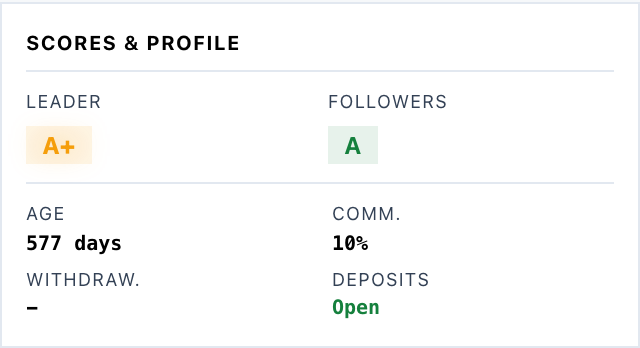
Every vault on Hyperliquid has a fee structure set by its leader. These fees determine how returns are split — and ultimately, what you take home as a depositor. Understanding them is essential before you commit capital.
How do vault leaders earn from their strategy?
Section titled “How do vault leaders earn from their strategy?”Leaders don’t charge depositors just to participate. Instead, they earn a commission on the profits they generate. The leader trades using the vault’s pooled capital. When the vault books a profit, the leader takes a predetermined cut; the remainder is distributed to depositors.
This model aligns incentives: if the leader doesn’t perform, they earn nothing from commissions. When they do perform, their compensation scales with the value they create.
One important thing to note: if a vault loses money, the leader earns no commission — but depositors absorb those losses proportionally. Fees only apply to gains.
What fee do vaults charge?
Section titled “What fee do vaults charge?”Only one fee exists on Hyperliquid vaults: a performance fee, taken as a percentage of profits.
Net Return = Gross Return × (1 - Performance Fee Rate)
If a vault earns 10% gross and the performance fee is 10%:
10% × (1 - 0.10) = 9% net return for depositors
The leader keeps the remaining 1% as their commission. The performance fee is fixed at 10% for user-created vaults. The HLP protocol vault charges 0%.
There are no management fees, entry fees, exit fees, or withdrawal penalties. The performance fee is the only cost depositors bear.
High-water mark
Section titled “High-water mark”Performance fees include a high-water mark. This mechanism prevents leaders from charging fees on the same profits twice. The high-water mark is the vault’s highest recorded value — the leader only earns performance fees on profits that exceed that peak.
Without a high-water mark, a leader could take fees every time the vault recovers to a previous high, collecting on the same upside multiple times after drawdowns.
Without high-water mark:
- Vault starts at $100 → grows to $120 (leader earns fee on $20 gain)
- Vault drops to $110 → grows back to $130 (leader earns fee on $20 again — the $10 from step 1 is double-counted)
With high-water mark:
- Vault starts at $100 → grows to $120 (leader earns fee on $20 gain, watermark set to $120)
- Vault drops to $110 → grows to $130 (leader earns fee on $10 — only the growth above $120)
High-water marks protect depositors from being charged on volatility rather than genuine growth. All Hyperliquid vaults include them.
Where can you find a vault’s fee structure?
Section titled “Where can you find a vault’s fee structure?”The vault detail page shows the fee rate and high-water mark level. Since the fee is fixed at 10% for all user vaults, there isn’t a variable structure to evaluate — the only differentiator is the leader’s trading performance.
How do fees affect your net returns?
Section titled “How do fees affect your net returns?”Gross APR can be misleading on its own. A vault with impressive gross returns but steep fees may deliver less to depositors than a modest performer with low fees.
| Vault type | Gross APR | Fee | Net APR |
|---|---|---|---|
| User vault | 30% | 10% perf | 27% |
| HLP | 30% | 0% | 30% |
The math is straightforward: a 10% performance fee takes 10% off the top of any profit. A vault generating 30% gross returns delivers 27% net to depositors. The same vault run as HLP (0% fee) would deliver the full 30%.
How do fees influence DP grade?
Section titled “How do fees influence DP grade?”The DP (Depositor Performance) grade measures net returns after fees — what depositors actually receive. When a vault shows a strong LP (Leader Performance) grade but a weaker DP grade, fees are usually the reason.
Common patterns that produce LP ≠ DP:
- High fees that consume a disproportionate share of returns
- Poor fee timing — a leader who takes fees at unfavorable points, locking in losses before a recovery
- Misaligned incentives — a fee structure that rewards the leader more than depositors, even during underperformance
If you spot a gap between LP and DP on a vault profile, investigate the fee structure first. It’s often the fastest way to understand what’s happening.
What varies between vaults?
Section titled “What varies between vaults?”Since every user vault charges the same 10% performance fee, fee structure isn’t a differentiating factor. The real variables when comparing vaults are the leader’s trading skill, the lockup period, and the strategy bias. These are covered in the Vault Evaluation Strategy guide.
Related
Section titled “Related”- Vault Evaluation Strategy — a systematic approach to picking vaults
- Performance Metrics — how LP and DP grades are calculated
- Pricing Plans — HL Vaults app subscription tiers